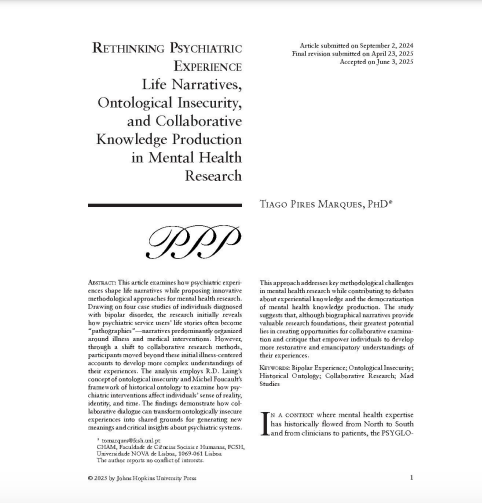
Rethinking Psychiatric Experience Life Narratives, Ontological Insecurity, and Collaborative Knowledge Production in Mental Health Research
Tiago Pires Marques
This article examines how psychiatric experiences shape life narratives while proposing innovative methodological approaches for mental health research. Drawing on four case studies of individuals diagnosed with bipolar disorder, the research initially reveals how psychiatric service users’ life stories ofen become “pathographies”—narratives predominantly organized around illness and medical interventions. However, through a shif to collaborative research methods, participants moved beyond these initial illness-centered accounts to develop more complex understandings of their experiences. The analysis employs R.D. Laing’s concept of ontological insecurity and Michel Foucault’s framework of historical ontology to examine how psychiatric interventions afect individuals’ sense of reality, identity, and time. The findings demonstrate how collaborative dialogue can transform ontologically insecure experiences into shared grounds for generating new meanings and critical insights about psychiatric systems. This approach addresses key methodological challenges in mental health research while contributing to debates about experiential knowledge and the democratization of mental health knowledge production. The study suggests that, although biographical narratives provide valuable research foundations, their greatest potential lies in creating opportunities for collaborative examination and critique that empower individuals to develop more restorative and emancipatory understandings of their experiences.
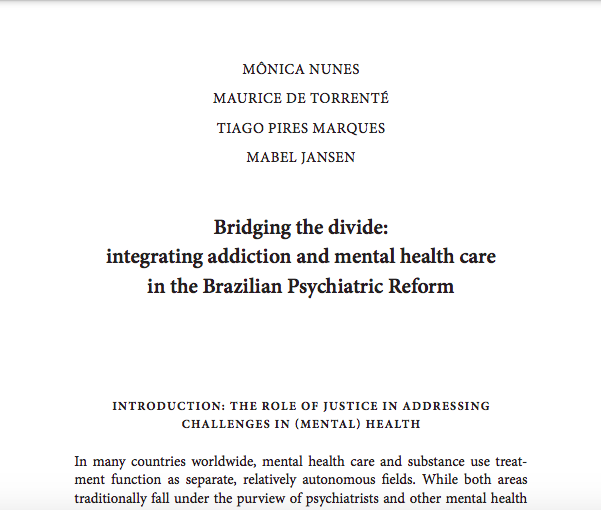
Bridging the divide: integrating addiction and mental health care in the Brazilian Psychiatric Reform
Mônica Nunes, Maurice de Torrenté, Tiago Pires Marques, Mabel Jansen
This article examines the complex relationship between mental health care and substance use treatment in Brazil, specifically analyzing how the separation between these fields has evolved within the context of the Brazilian Psychiatric Reform (rpb). Through qualitative research involving in-depth interviews with mental health professionals, legal professionals, and mental healthcare users in the state of Bahia, the study explores how the historical divide between mental health and drug addiction treatment has shaped care practices and policies. The research argues that the apparent division between mental health and substance use treatment masks a deeper unity in their challenges, as both fields confront similar institutional logics of control and segregation. The article concludes that advancing a truly democratic psychiatric reform requires moving beyond the health-versus-justice dichotomy to address the intersecting issues of racism, social justice, and human rights in both mental health and addiction care.
keywords: mental health policy; anti-asylum movement; drug policy; harm reduction; therapeutic communities; social movements.
Reexistir por Linhas Transmutáveis – Histórias da Reforma Psiquiátrica e da Luta Antimanicomial Baiana
Em maio de 2024, mês da luta antimanicomial, o Projeto Psyglocal realizou diversas atividades, diálogos e debates na cidade de Salvador - Bahia, com as presenças de profissionais da RAPS, convivas e grupos como o Papo de Mulher, Associação Metamorfose Ambulante de Usuários e Familiares do Serviço de Saúde Mental - AMEA, Comunidade de Fala, além de outras coletividades existentes nos CAPS soteropolitanos. Esses encontros ocorreram através da parceria da Universidade de Coimbra (Portugal) e a Universidade Federal da Bahia (Brasil), onde se buscou discutir e fortalecer o atual cenário da militância na capital baiana, além de proporcionar trocas entre os movimentos antimanicomiais europeus e brasileiros.